
Protected Case Study
Research Studio
This case study is password protected and intended for hiring managers only.
Incorrect password. Please try again.
Research Studio
From Chat to Craft: Recentering Research Around the Study
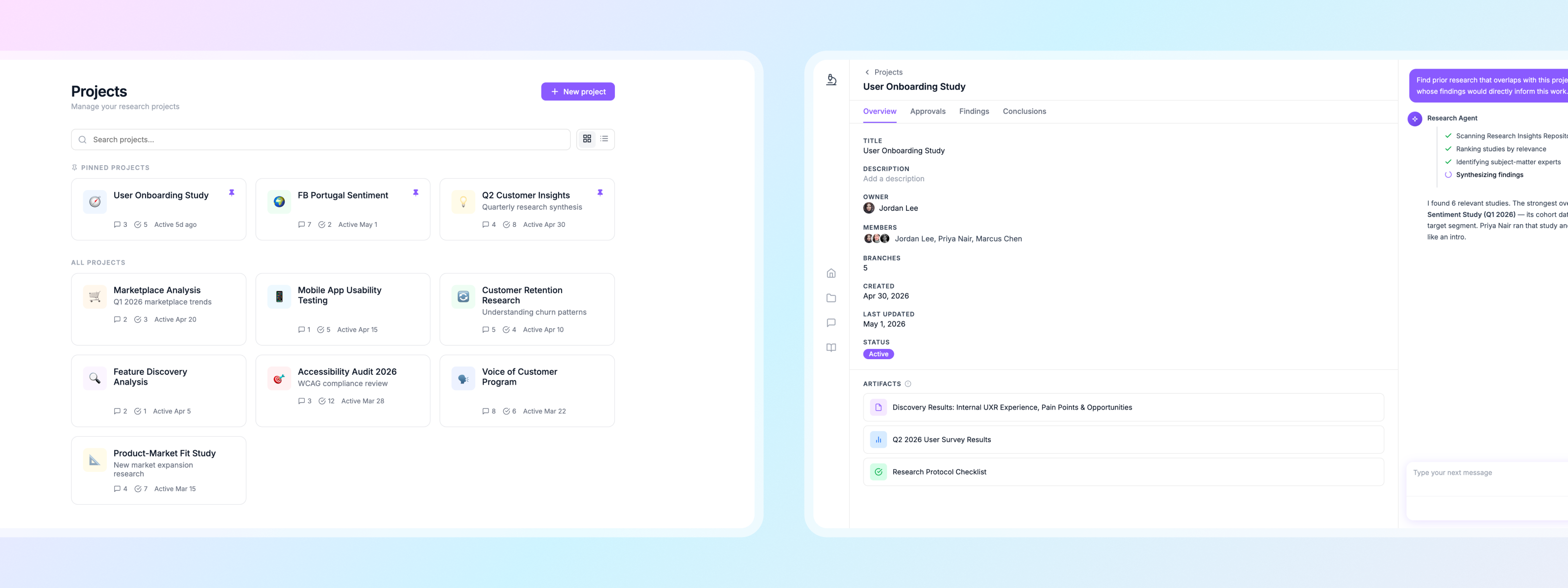
Research Studio is Meta's AI-native research platform — a single place where researchers run the full lifecycle of a study, from brief to shareout. I led design through the Alpha-to-Beta rebuild, driving a fundamental pivot: away from a chat-first experience and toward a project-centered system where every artifact, conversation, finding, and approval lives in one place. The north star that shaped everything: AI assists, not automates.
Research at a Crossroads
Meta's product cycle had compressed dramatically. AI-led acceleration had shrunk design and engineering timelines from months to weeks. The research org hadn't kept pace. The traditional cycle — file a request, wait 4–6 weeks, receive a deck after the product had shipped — was no longer compatible with how Meta builds. Research was becoming either a bottleneck or an afterthought.
The leadership ask was direct: make research as fast and AI-native as the rest of the product stack. The research org's concern was equally direct: don't automate away the judgment that makes research useful in the first place. Both were right. The design role was to find the path that honored both.
My Role
Product Design Manager, Meta · Design lead on Research Studio Beta. Working with: 1 EM, 2 engineers, 1 PM, 1 UXR partner, 1 content designer. Scope: Beta strategy, design principles, UX system, scoping framework, Research Ambassador rollout.
Core User Problems
- Research outputs were scattered across team drives, email, and disconnected tools — knowledge silos with no central record
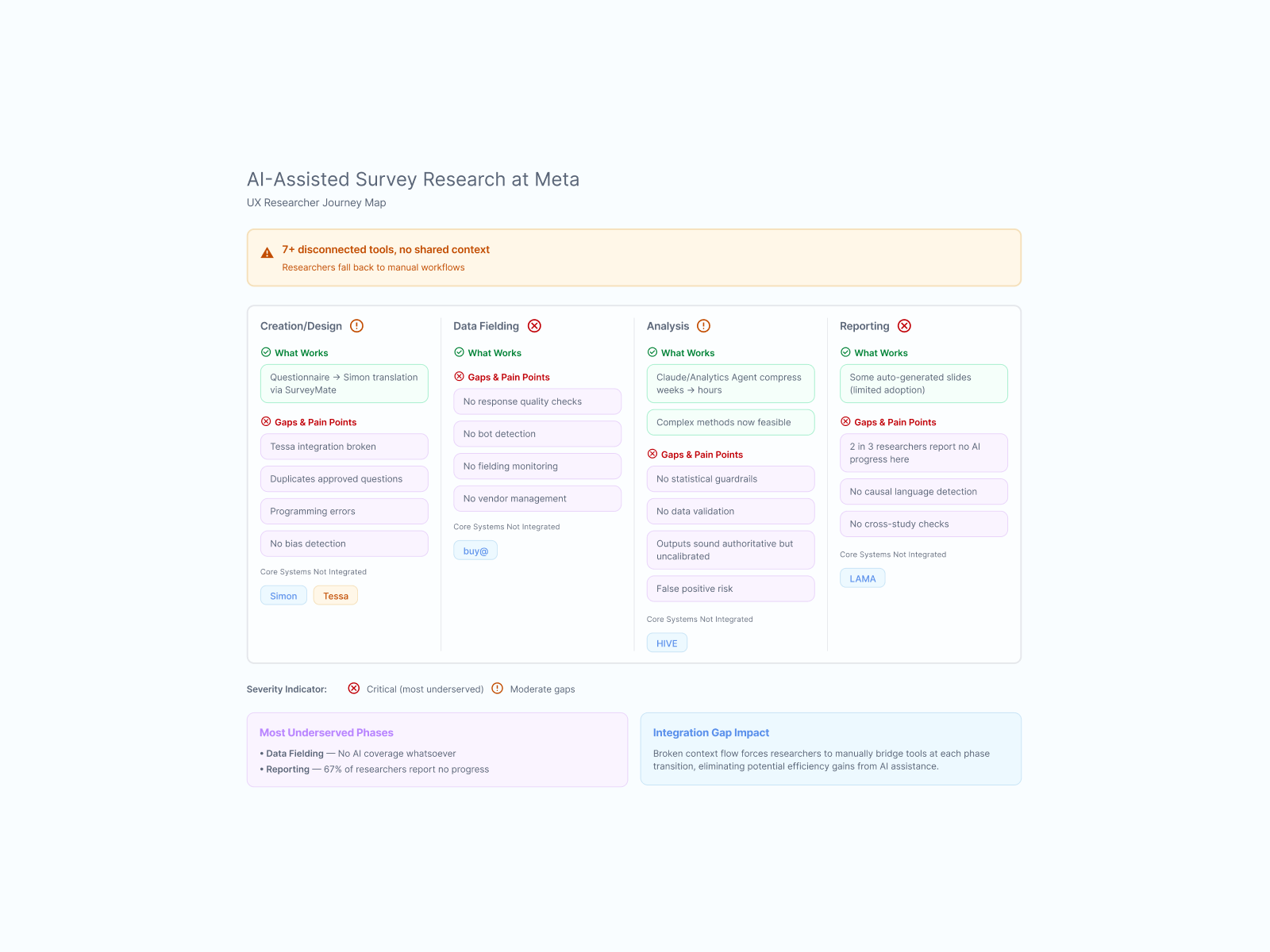
- Manual, repetitive pre-field work consuming ~61% of researcher time
- Fragmented tooling across six or more platforms (survey tools, docs, project trackers, research repositories)
- Limited access for non-researchers — PMs, designers, and engineers couldn't easily find past insights
- Trust fragility — the org needed AI to sharpen research thinking, not replace it
How might we make Research Studio the place where a study lives — not just another tool researchers talk to?
Alpha answered the wrong question well. It gave researchers a fast, capable chat interface — and they used it. But after each session, the output landed in the same fragmented sprawl as before: a discussion guide in Google Docs, findings in a deck, approvals in email. The AI was useful. The work was still scattered.
The Beta design question wasn't about velocity — it was about coherence. Could we make the project the permanent home of a study, so that every artifact, conversation, finding, and approval existed in one place from brief to shareout? After Alpha shipped in March 2026, the eval data confirmed the path: go narrower and deeper, centered on the project as the organizing unit.
Our Strategy
Chat is a tool, not the home. The project is where the study lives — from first artifact to final shareout — giving research a permanent, trackable record instead of scattered outputs.
The researcher's expertise becomes the quality layer, not the production layer. Every flow has a human checkpoint where researcher judgment is the deciding voice.
Researchers spend ~61% of their time pre-field. Compressing that from 3–4 weeks to 2–4 days delivers the velocity story without overreaching.
Coverage is the trust foundation. Without it, every output is suspect. With it, even imperfect outputs are debuggable.
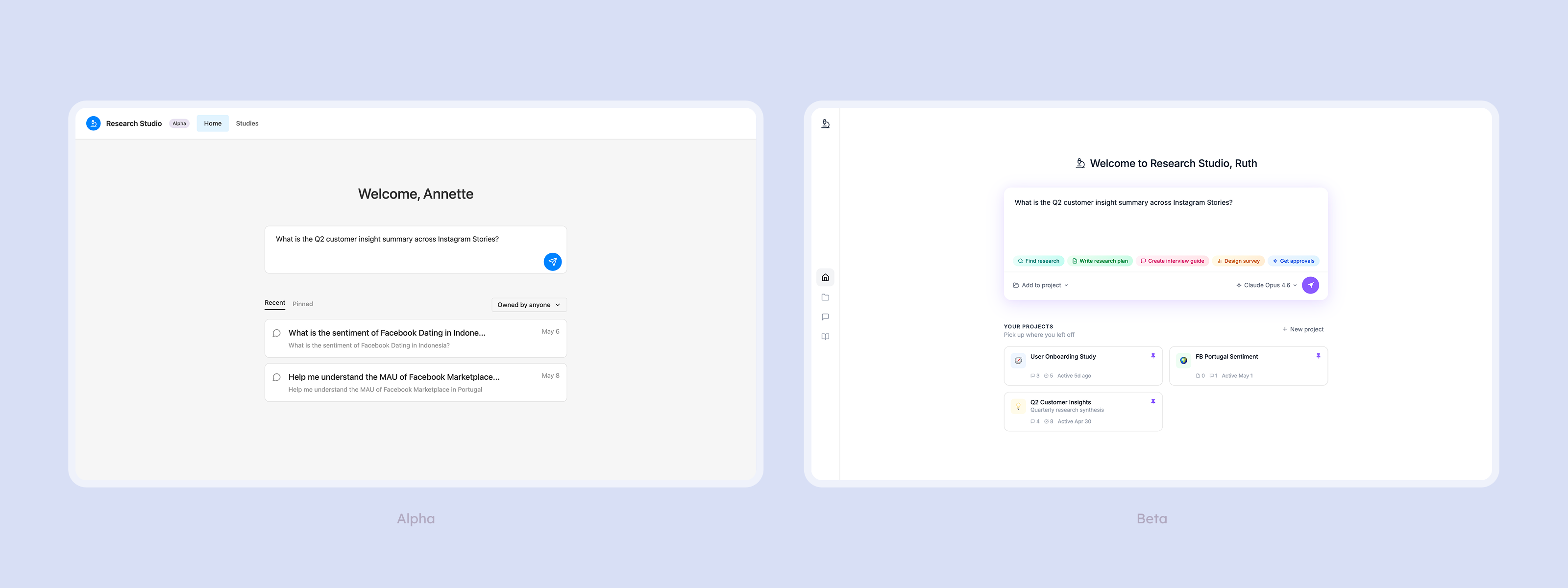
The Pivot: From Chat History to Research Record
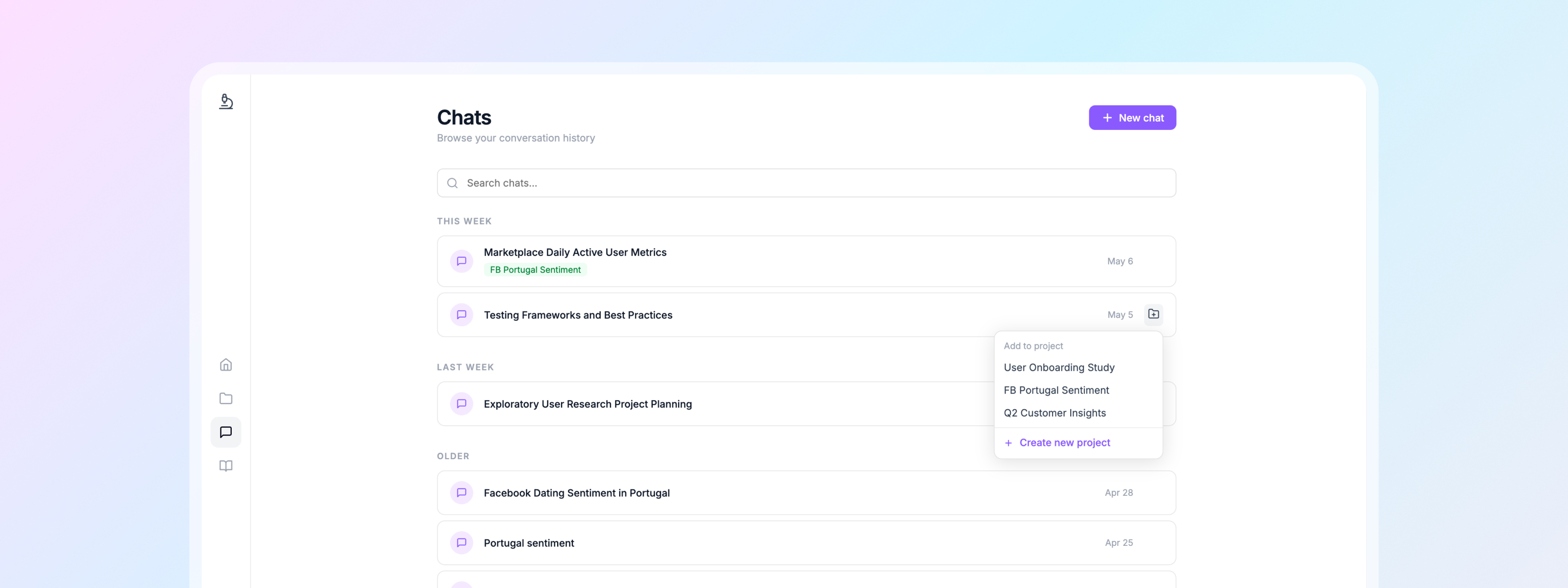
Alpha looked like a search box with memory. You typed a question, got an answer, and a list of past conversations accumulated below. It was familiar — and it reproduced exactly the fragmentation it was supposed to solve. Chats weren't connected to studies. Artifacts lived elsewhere. There was no through-line from question to finding to shipped research.
The Beta pivot was structural: the study, not the conversation, became the unit of work. A Project is a permanent container that holds everything generated in the course of a research study — AI-generated artifacts, researcher-created documents, chats with the agent, synthesis, approvals, and the final shareout. Chat doesn't disappear; it becomes one tool within a project, anchored to the work rather than floating alongside it.
- Create or enter a project — start fresh or promote an existing chat into a project
- Generate pre-field artifacts — discussion guides, screeners, and research plans created by AI within the project context
- Conduct and synthesize — field notes, findings, and conclusions live in the project alongside the AI's reasoning
- Approve and share out — approvals tracked and distributed directly from the project, with full audit trail
Reframing Beta Scope Around Pre-Field Velocity
The most important design decision on this project wasn't a UI choice — it was the scoping reframe written into the Beta PRD. If we compressed pre-field from 3–4 weeks to 2–4 days, total lifecycle compression from 7–11 weeks to 3–5 weeks followed naturally.
- Four launch-blocking skills: Discovery, Planning & Design, Discussion Guide, Survey/Screener
- Three skills explicitly deferred: Quant Analysis, Qual Analysis, Report/Shareout
- Trade-offs written directly into the PRD so the whole team could hold them
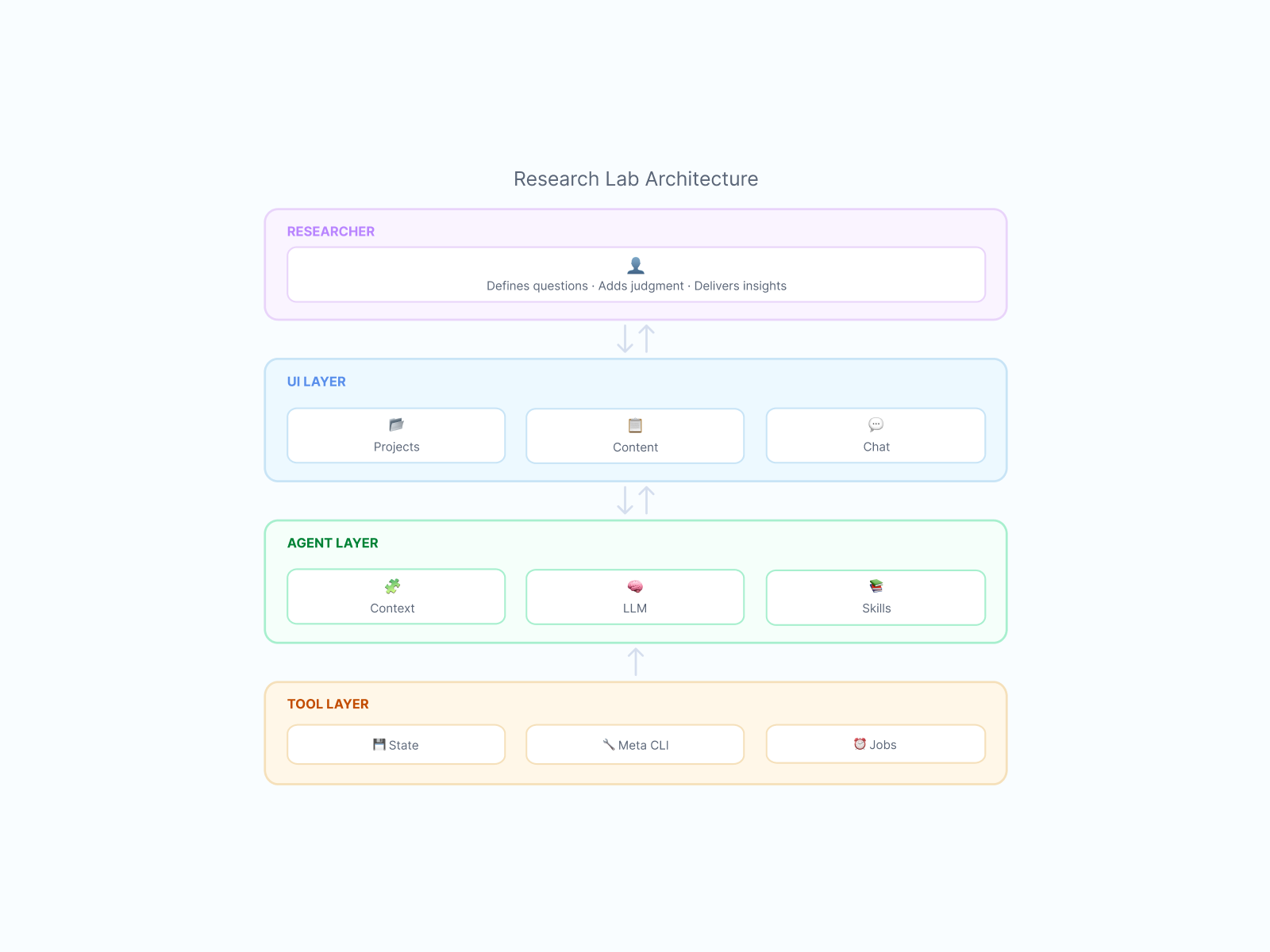
Architecture as a Product Decision
Alpha's dependency on Mise recipes was framed by engineering as a latency problem. I reframed it as a product problem — the agent's capability ceiling was set by infrastructure choices, and that ceiling was capping what we could design for. Design has to know enough about the substrate to advocate for the right one.
- Search latency: Vector DB (3 min) → Laser KNN (300ms)
- Data coverage: GDocs 8% → 93% · GSlides 0% → 99.9%
Designing the Human Checkpoint Into Every Flow
"AI assists, not automates" had to do real work — not just sit in a deck. I worked with engineering and content design to translate the principle into concrete interaction patterns.
- Discussion Guide: agent generates, researcher edits — no "approve and ship" affordance
- Planning & Design: methodology recommendations include reasoning, alternatives, and an override path
- Compliance: auto-populates required forms; researcher reviews before submission
- Reasoning UI: visible retrieval, synthesis, and filtering steps at every turn
Shipped Metrics, and a Posture Shift That Matters More
Beta launched in May 2026. The qualitative outcome that matters more than any number: the research org has stopped framing AI as a threat to craft. Twenty-two Research Ambassadors across Meta drove Beta adoption inside their pillars.
Research lifecycle compression delivered with Beta
Data layer at 20s latency — exceeding the 80% target at launch
Agent layer threshold held across all four pre-field skills at launch
Design-led distribution network spanning Meta, ABM, Reality Labs, and Meta Superintelligence Labs
The Data Layer Is Running Ahead of the UI
The data layer is the most strategically interesting part of this work — and it's already running ahead of the UI. In the Scale phase, PMs, designers, and engineers will be able to query it directly with appropriate guardrails.
The harder open question: whether researchers actually use the agent as a partner or revert to using it as a search box. The design principle is only as real as the behavior it produces.
Status
Beta launched May 2026 · Scale phase in planning
The hardest part of designing AI products is not the model. It is the scoping. AI tempts you to build everything because the model could, in theory, do everything. The discipline is choosing what not to build, so the part you do build is actually trusted.
- Scope is a design artifact. Write the trade-offs down so the team can hold them.
- A principle isn't real until it constrains a decision you would otherwise have made differently.
"Evaluate me on the features I argued against shipping, not just the ones I shipped."